Topics

November 23, 2026


November 23, 2026
The way consumers shop on Black Friday and Cyber Monday (BFCM) is evolving.
The hunt for the best deal no longer has to mean camping out for doorbusters, bouncing between retailer websites, or scrolling endlessly through product reviews.
AI is becoming part of the shopping journey, helping consumers research purchases, compare prices, and narrow down their options before they buy.
But there's a catch: Shoppers want AI to do the legwork, not make the final decision.
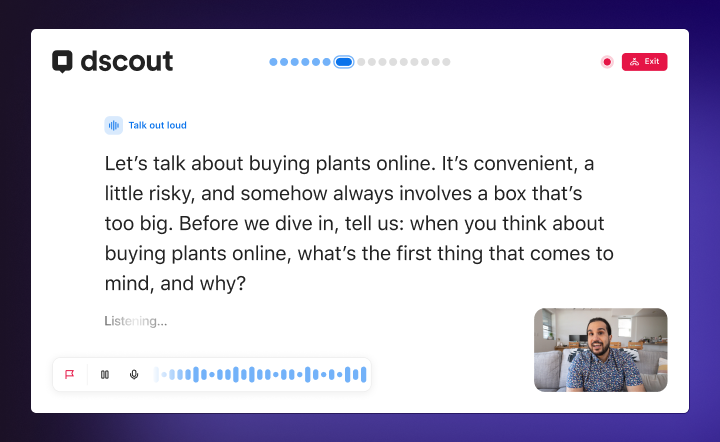
To understand how AI is influencing holiday shopping, we ran 100 AI-moderated research sessions exploring how consumers plan to shop, find deals, and make purchasing decisions this Black Friday and Cyber Monday.
Below, we share a few highlights of what we learned—and what retail and ecommerce teams should be thinking about beyond the holiday season.
Interested in the full report? Grab it here!
Many reported that they felt visiting a physical store was optional or reserved for a specific purpose.
This makes the digital shopping experience more important than ever. But the journey isn't necessarily starting and ending on a retailer's website.
50 out of 100 shoppers are expecting to do most of their Black Friday and Cyber Monday shopping online.
AI assistants are creating another way for consumers to research products, discover deals, and decide which retailers deserve their attention.
What this means for retailers: Think beyond the traditional ecommerce funnel. Understand how shoppers discover your products before they reach your website, including the role AI assistants play in shaping their consideration set.
Shoppers often already knew what they wanted—their challenge was figuring out where to buy it.
Rather than manually checking multiple websites, they saw AI as a way to simplify the comparison process.
58 out of 100 shoppers described using or wanting AI to compare prices for specific items across retailers.
For retailers, this introduces an important distinction: Product discovery isn't always about introducing shoppers to something new. Sometimes, it's about helping them feel confident they're getting the best value on something they've already decided to purchase.
What this means for retailers: Accurate pricing, promotion details, availability, and product information matter beyond your own website. Test whether shoppers can easily validate the prices they discover through AI and move from comparison to purchase without unnecessary friction.
AI might make shopping faster, but shoppers aren't necessarily taking its answers at face value.
61 out of 100 shoppers wanted source links, original retailer pages, or an opportunity to independently verify AI-generated information about prices, promotions, products, or availability.
That behavior reveals something important: Convenience alone doesn't create confidence.
Consumers still want to know where information came from, whether an offer is legitimate, and if the details are current.
A compelling AI recommendation can lose its value quickly if the price doesn't match the retailer's website or the advertised product is out of stock.
What this means for retailers: Trust needs to be designed into the entire shopping journey. Make product details, promotions, and availability easy to verify. Research where shoppers encounter uncertainty and what information helps them confidently move forward.
One of the clearest findings from the research was how shoppers divided responsibilities between themselves and AI.
66 out of 100 shoppers explicitly wanted to retain control of the final product choice or checkout, even when allowing AI to research, compare, or shortlist options.
In other words, shoppers are comfortable delegating tasks without delegating decisions.
They may welcome an AI assistant that finds five promising products, summarizes the differences, or identifies a better price—but that doesn't mean they're ready to let it complete the purchase.
What this means for retailers: Don't assume that AI adoption automatically means demand for autonomous shopping. Focus on designing experiences that support informed decisions, seamless handoffs, and shopper control.
Shopping for someone else introduces a different challenge: Knowing what to buy in the first place.
17 out of 100 participants described actually using AI to explore gift ideas for a specific person, such as a partner, friend, niece, or family member.
Some provided details about the recipient's interests, preferences, and budget to generate more relevant suggestions.
Importantly, asking AI for gift ideas doesn't mean shoppers purchased the recommendations.
Still, the behavior points to an opportunity for retailers to better support gift discovery, especially when consumers don't know exactly what they're looking for.
What this means for retailers: Explore experiences that help shoppers discover gifts based on recipients, interests, occasions, and budgets. Then test whether those recommendations feel relevant enough to move shoppers toward a purchase.
While discounts remain central to Black Friday and Cyber Monday, shoppers aren't evaluating products on price alone.
51 out of 100 shoppers described weighing factors such as features, reviews, safety, sizing, or intended use alongside sale prices.
They wanted help understanding whether a product was actually right for them—not simply whether it was discounted.
This suggests that AI's value extends beyond finding bargains. It can also help consumers make sense of complicated product information and compare tradeoffs.
What this means for retailers: Product content should answer the questions shoppers actually have. Clear specifications, useful reviews, sizing guidance, and transparent comparisons can help shoppers evaluate fit and quality with greater confidence.
Black Friday and Cyber Monday offer a timely window into changing shopping behaviors, but these findings have implications far beyond the holiday season.
For retail, ecommerce, product, and CX teams, the opportunity isn't simply to add more AI to the shopping experience.
It's to understand where AI genuinely makes shopping easier—and where consumers still need reassurance, transparency, and control.
The answers won't be the same for every shopper, product category, or purchasing occasion.
And that's precisely why continuous customer research matters!
Want to see how 100 people really feel about AI and shopping? The full report goes deeper on trust, price comparison, and gift discovery, with takeaways your team can act on in 2027.

See what 100 shoppers reveal about the future of AI-powered retail, and what retailers should consider doing next. Grab your copy!