Topics

July 29, 2026



July 29, 2026
UXRs, designers, and product leaders all know—the pressure to produce right now is very real.
Leaner teams, tighter timelines, and the race to ship AI-driven products are compressing delivery cycles like never before. Researchers have always felt the pressure to fast-forward to insights, but the urgency has accelerated to a breakneck pace.
Today, the expectation isn't just about moving quickly, it's about scaling operations without losing the integrity of the data (tall order).
This creates intense operational friction where research quality can easily wind up on the chopping block if teams aren't careful.
In the webinar Make Quick and Confident Business Decisions with UXR, Dscout’s Colleen Pate and GAIN Conversion’s Harriet Swan discussed how to scale research with AI, without sacrificing confidence in product decisions.
AI workflows promise flawless efficiency in theory, but the actual day-to-day practice of scaling these tools can get extremely messy. To properly navigate this transitional space, teams need both the permission and time to test tools, fail, and iterate. They need time to play with them, learn how to spot the gaps, and address them before re-vamping the entire workflow.
In the initial stages, running an automated process might take exactly the same amount of time—or even longer—as your legacy manual systems, and that is a perfectly normal part of the learning curve.
Embracing this challenge directly is the only way to avoid systemic tool fatigue and widespread AI burnout across your department.
Instead of seeing using human and AI strengths as a zero-sum game, it helps reframe and see how they act as an integrated unit rather than opposing forces.

For example, your team can outsource work that humans often burn out on or can’t do as quickly—like repetitive tasks—to free up people to focus on creative, original thinking.
AI can also help with pattern recognition quickly across large datasets, while still leaning on the strength of human intelligence and context-driven judgment. Ultimately, these skills and tools are complementary and symbiotic.
The structural architecture of a research study is shifting from a slow, linear task list to a fluid, augmented collaboration.
Despite the rapid shift in technical tools and product delivery cycles, the foundational role of the UX researcher is still the same. UXRs aim to keep users squarely at the center of every product, marketing, and design decision and strive to prevent corporate assumptions from overriding human needs.
So as companies launch AI features and tools faster than ever, the demand for authentic human insight actually increases rather than shrinks, because tech-forward teams can easily lose touch with real consumer realities.
And the staggering "experience delivery gap" highlights why proactive user advocacy is more critical today than ever before. While 80% of companies firmly believe they deliver a superior experience, a mere 8% of their actual customers agree with them.
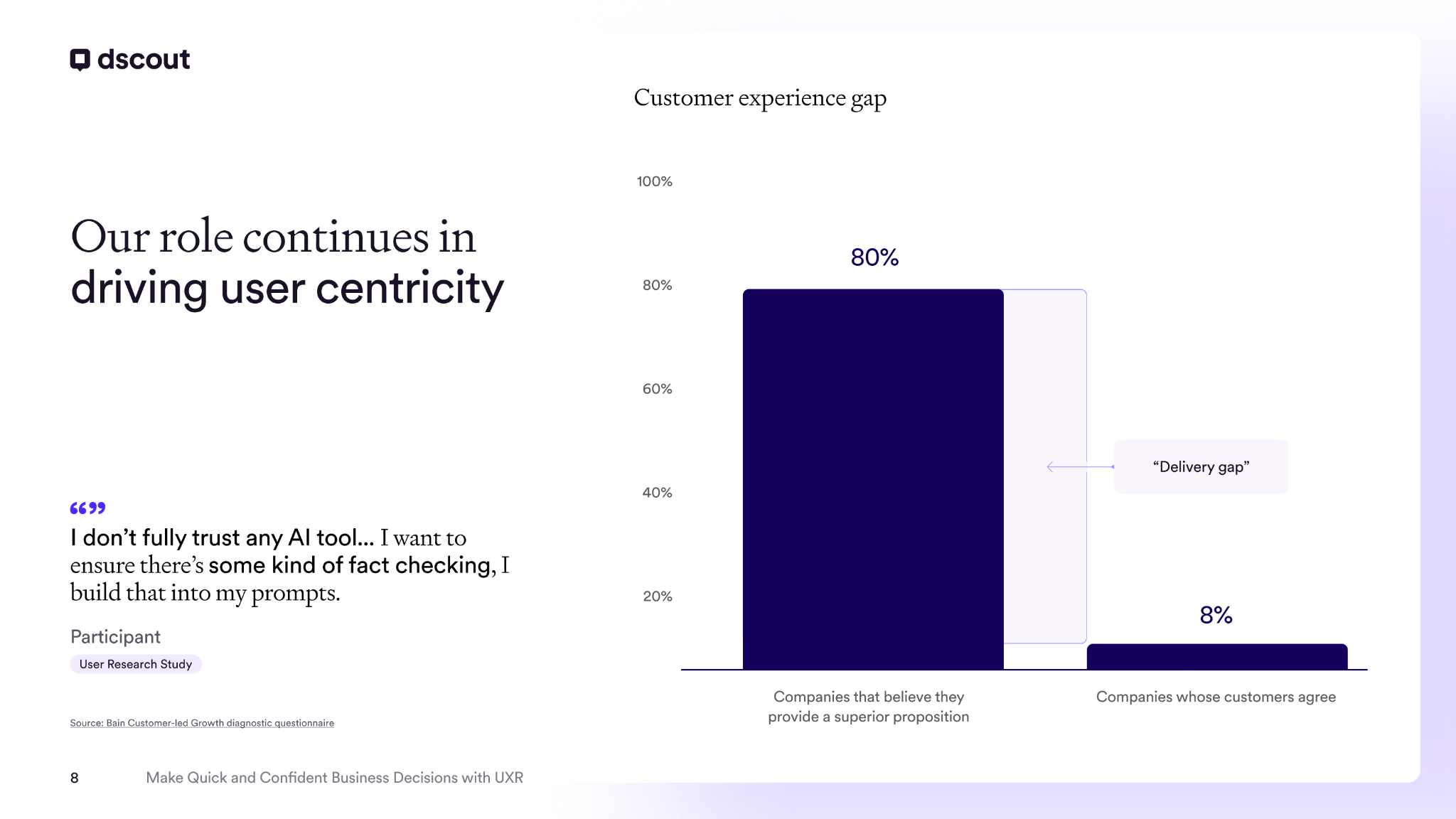
Closing this chasm requires researchers to actively study shifting user mental models, uncover target market skepticism, and ensure that new tech features alleviate documented human friction points—rather than satisfying internal corporate trends.
Moving fast doesn’t mean very much if your team is moving at lightning speed in the wrong direction. To achieve true balance, it’s critical to build a system where speed and confidence go hand in hand.
The best way to do that is to…
Teams struggle with this critical step because corporate silos often force researchers into a reactive state. To help align teams, try moving into corporate discovery. This separates superficial design requests from deep commercial objectives to ensure you focus limited resources on high-impact questions.
In order to have high confidence in your insights and recommendations, it’s important to have a robust suite of methodologies that span quantitative, qualitative, behavioral, and attitudinal data. Relying on a single data source creates critical blind spots.
Embrace a cultural shift away from legacy academic models that stall execution for months in search of a perfect study. Using the "MVP of research" by deploying smaller, more frequent study cadences prevents your data from expiring before it ever reaches a PM, designer, or developer's desk.
Find creative ways to overcome cross-functional teams unknowingly duplicating past research studies. By structuring your legacy research data cleanly, you can leverage language models to dynamically query institutional memory, allowing teams to see what is already known before starting new projects.
Cultivating an active test-and-learn rhythm means shifting your team from a state of short-term firefighting into an intentional, highly organized cadence.
On an organizational level, doing the following will help you achieve these goals:
Establishing a resilient test-and-learn ecosystem requires an organization to actively move away from relying on isolated data practices. Research leaders can champion a matrix of methodologies mapped directly across two primary operational axes:

Standard qualitative attitudinal methods, such as user interviews or focus groups, are great at charting deep consumer mental models, hidden motivations, and perceived pain points. But these methods only show what users think or say they care about, completely missing how they actually interact with real-life systems.
It’s best to blend your qualitative findings with quantitative behavioral tracking like live product analytics and A/B testing because what participants say during a research panel doesn’t always match how they actually behave when they use a tool or feature in real life.
By connecting behavioral trends with attitudinal clarity, you can confidently determine whether an optimization change is actually the best move.
GAIN Conversion shared how they used structural triangulation to find the best solution for their client in the healthcare space.
For context, their client operates medical centers across two divisions: eating disorder rehabilitation and general mental health care. The team initially made a standard homepage layout redesign for the eating disorder division based entirely on proven usability principles.
They updated a few things including…
In production, this behavioral experiment unlocked double-digit growth, significantly boosting direct customer inquiries.
Assuming they had uncovered a flawless template, the team copied the layout and call-to-action modifications on the client's sister mental health care website. To their surprise, the behavioral results were entirely flat, with zero conversion improvement or patient engagement.
Rather than guessing blindly or randomly changing design variables, the team deployed Dscout to run a rapid qualitative study investigating the core motivations of the mental health audience. The attitudinal findings revealed a profound emotional insight: prospective mental health patients felt completely overwhelmed by options. They deeply feared being processed through a cold, depersonalized experience. The patients needed psychological reassurance that their care would be individualized to their specific life circumstances.
Armed with this deep qualitative insight, the team modified their behavioral experiment. They kept the optimized usability layout framework, but changed the copy of the main hero headline to speak directly to the user's emotional needs: "Mental wellness that's right for you".
By combining behavioral tracking with deep attitudinal context, the team validated the qualitative finding through live product execution. This single copy shift—uncovered by UXR and validated via an A/B test—unlocked an immediate 20% double-digit conversion growth in inquiries.
Created by Harriet and the team over at GAIN Conversion, the Levers Framework helps companies make evidence-based decisions.
Think of a “Lever” as a feature of the UX experience that influences user behavior. The Levers Framework acts as a taxonomy of the features of UX.
This framework is structured like a hierarchical tree, describing changes to UX at three levels:
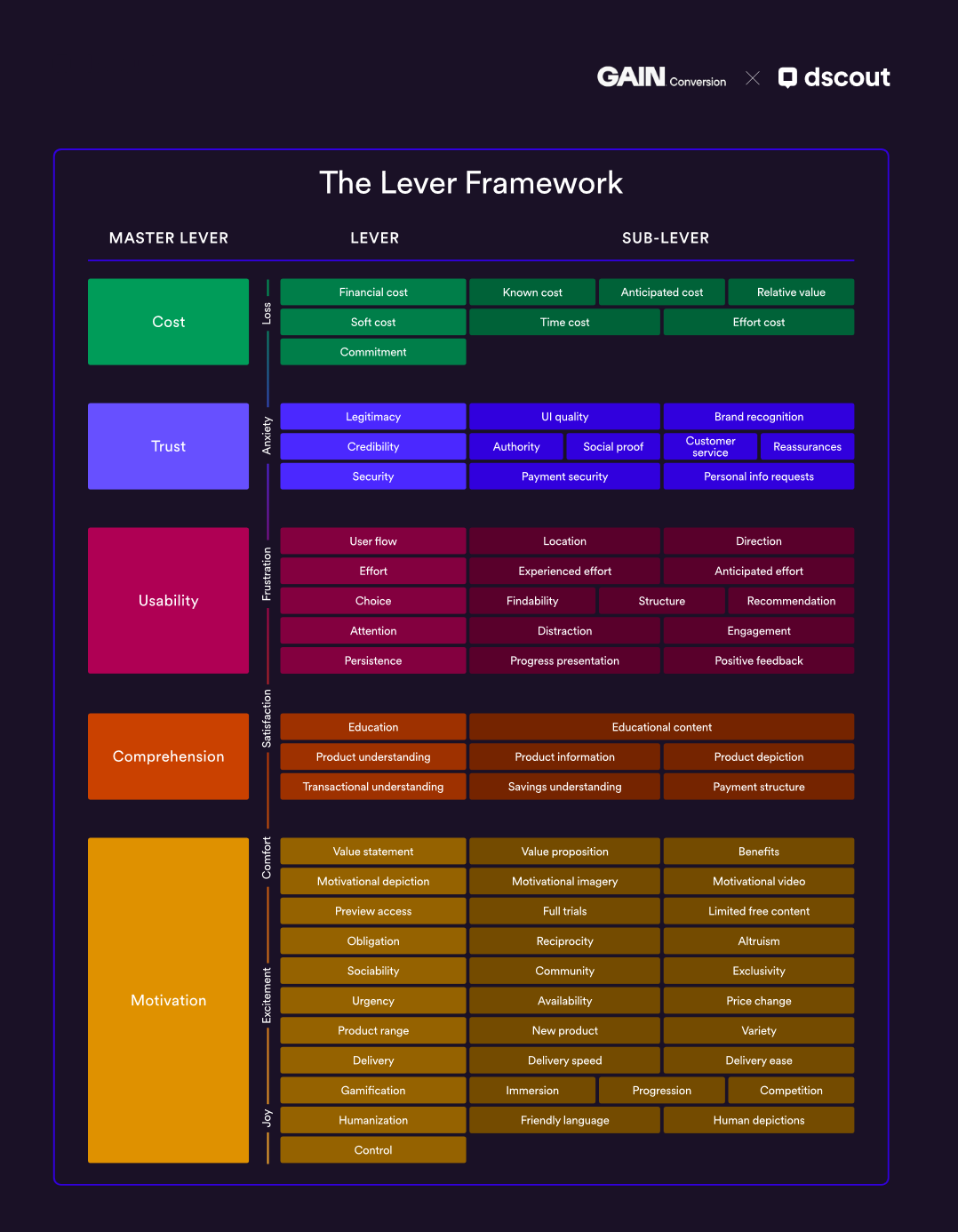
You can use the Levers framework for the following:
Want to learn more about the Levers Framework and how to apply it to your everyday practice? Grab the free download.
While AI continues to press the speed and scale of product development, the fundamental mission of UXRs remains the same. Our mandate is to act as fierce user advocates, ensuring that critical business strategies are driven by human insights (rather than internal corporate assumptions).
Speed to insight is meaningless without strategic accuracy. By actively transforming your department from reactive research into a mixed-method, test-and-learn operation, you give your organization both the agility required to navigate the market and the confidence required to bring results.

A free, practical breakdown of the levers, sublevers, and how to use them in your day-to-day research.